
2016 Jan 31
Homegrown hotel group Uga escapes is hoping to rival the international chains at the very top of the market
Offered the chance to ride shotgun in a helicopter, I leapt at the opportunity. As anyone who has ever negotiated the roads in Sri Lanka knows, driving can be slow. The journey from Colombo to Ulagalla, 175km north-east of the airport, had taken almost five hours; the place we were moving on to was almost 350km south. A chopper seemed the way to go.
It was raining, but even so the views were sensational. We glimpsed a column of elephants, their backs like great grey boulders, lumbering through the verdant landscape, then circled the ancient citadel of Sigiriya, which sits atop a 200 metre-high column of rock, before landing, unexpectedly, at a military airport, swooping down past what appeared to be an open missile silo in order to refuel. It was only after we were airborne again that the bad weather really set in. The cloud descended until visibility was negligible. And then the screen on the dashboard turned orange and began to flash “TERRAIN ALERT”. The pilot’s concern was palpable. There was nothing for it but to alter course away from the mountains and land, alighting several long minutes later on the worn wicket of a waterlogged cricket pitch in a remote town called, we learnt later, Dehiattakandiya.
There was no possibility of flying on, the pilot said, and he could not leave his aircraft, so, wondering what was going to happen next, we made our way to the town’s hotel, where the solicitous manager seated us at a table in its fluorescently lit banqueting hall, offering us hot tea and, more surprisingly, chips. Meanwhile, many calls were made on our behalf. The man who ran the shop had a car that would take us just as soon as someone could be found to drive it. So eventually we continued by road. What should have been an hour’s flight turned into a 10-hour odyssey.
Our destination was Chena Huts, a small safari lodge that opened just before Christmas on the edge of the Yala National Park in the barely developed south-east of the island. Our adventure hadn’t ended. The talk in the dining room the next evening was of a kill that afternoon, outside hut 7. A saltwater crocodile had emerged from the watering hole, caught a sambur — a kind of large antlered deer — and dragged its carcass into the water. There was speculation among the rangers that it might attract the two leopards that had been seen a couple of days previously. In the end it just drew more saltwater crocodiles. These are the largest of all living reptiles, reaching five or six metres in length and weighing more than a tonne. Suddenly the advice that we should not walk from our cabins to the main building unescorted by a member of staff seemed not nannying, but wise.
Recent years have seen the luxury hotel market in Asia and beyond increasingly dominated by fast-growing international chains (the likes of Aman, Banyan Tree, Six Senses and so on). So it is intriguing to find in Sri Lanka a home-grown player aspiring to rival those groups in the highest league of the hospitality industry. Chena Huts is the fifth property created by Uga Escapes, a growing brand of boutique hotels launched in 2010 by Priyanjith Weerasooriya, vice-president of the Finco Group. This is one of Sri Lanka’s largest privately owned conglomerates, founded by his grandfather in the early 1960s as a manufacturer of safes, since when it has embraced construction, engineering and IT. Hospitality seemed an obvious next step.
Not quite a decade ago, Weerasooriya had happened upon and bought a dilapidated manor house built in 1916, along with the 23ha estate on which it stood. It’s an appealing part of the country, close to the sacred city of Anuradhapura, the ancient Sinhalese capital, on which Unesco bestowed World Heritage status in 1982. But the following year, the civil war broke out, ravaging this part of the country for the next 26 years and making its giant bell-shaped stupas, once the largest brick structures on earth after the pyramids of Giza, largely off-limits to tourists, who even now are a rare sight here.
By the time a fragile peace was established in 2009, the recession was also taking its toll on Finco’s building interests, and it occurred to Weerasooriya that he could use his underemployed workforce to rebuild the estate. “At first we thought we’d probably sell it,” he told me over a gin and tonic in another of his hotels, the 11-suite Residence, which opened last May in a handsome mansion in Colombo. “But then the war ended, and we thought: Why not turn it into a hotel? This was a part of the country that needed investment and jobs, and we’ve always been a company that built businesses from the ground up.”
The result was the first Uga resort, Ulagalla, where we’d begun our trip: 20 spacious, secluded, largely solar-powered “chalets”, overlooking rice fields and reservoirs rich in waterfowl. Open since 2010, it is a place of rare delight, thanks not least to the beauty of its setting; its excellent chef, Chandana Gunawardena, whose lacy “hoppers” (crisp bowl-shaped rice-flour pancakes), fragrant coconut sambal and yellow dal are all I ever want to have for breakfast; and infinitely winning staff (I grew rather to enjoy being addressed as “dear ma’am”, as one of the waiters called me, while another concluded every order with the exclamation: “I will provide!”).
This is not a beach to lie on in case you encounter the elephants or wild buffaloes that have taken to visiting
It isn’t as “designed” as an Aman resort but even so, it came as no surprise to learn that its Portuguese general manager, Francisco Tamagnini, had come from Amanusa in Bali. In terms of the way its rooms are equipped — a pair of bikes on which to explore the estate, a Geneva sound system, a maddening lighting set-up controlled via touchscreen — its efforts to be luxurious are evident, even if there was the odd anomaly such as the fact that there is only hot water when the air conditioning is running. But such is the overall charm of the hotel, its staff and its setting, that the occasional shortcoming scarcely matters. When it comes to hotels, Sri Lanka is not yet a destination to rival Mauritius or the Maldives, and all the more alluring for it. It isn’t slick, but I loved it here.
Anuradhapura aside, the other attraction of this part of the country is Wilpattu, the largest, oldest and least frequented national park in Sri Lanka, a couple of migrating elephants from which had recently rampaged through Ulagalla’s vegetable garden in search of fruit. Five hundred leopards are reckoned to survive on Sri Lanka, both here and in an even greater concentration in the Yala National Park in the south-east of the island, a landscape of low scrub, tall trees and massive, striated red rock formations and, at 1,260 sq km, the country’s second largest park. Right on the edge of it is Chena Huts.
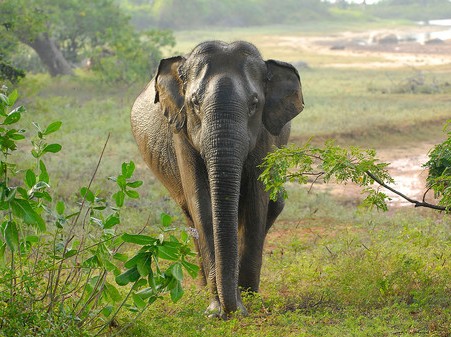
This, too, was a bit of the country blighted by the war, but it suffered yet worse devastation in the 2004 tsunami, which destroyed what little development there had been on this coast. The resort stands alone on the edge of a dark-sand beach but it is still 100 metres from the shoreline, the minimum distance now permitted between buildings and the ocean. The currents here are too fierce for swimming and, in any case, this is not a beach to lie on in case you encounter the elephants that, drawn by its unusually rich vegetation, have taken to visiting, as has a herd of wild buffalo and the occasional jackal. (I witnessed them all from the comparative safety of the main veranda.) Similarly, there is no room service, and you won’t find a bowl of fruit on your arrival lest the food attracts wildlife.

Chena Huts is the most lavishly furnished of the five Uga Escapes that have opened to date. (There are two further north on this coast: near Trincomalee, where the attractions include 40-strong “super pods” of whales; and near Passekudah, close to where the British aircraft carrier HMS Hermes was sunk by Japanese kamikaze bombers in 1942, now by all accounts a compelling dive site.) It consists of 14 thatched dome-like “huts” modelled on the structures lived in historically by local farmers, though here they have solid, poured-concrete substructures that, from inside, call to mind the gothic vaults of a cathedral. Out back there’s a large deck with a Jacuzzi-cum-plunge pool, sunloungers and dining area. It probably won’t win prizes for the design of its rather dark and overwhelmingly brown interiors but in terms of comfort you’ll want for nothing.
The staff includes two engaging Sri Lankan rangers, Steuart Roelofsz and Haritha Pilapitiya, experts in the local fauna and flora as well as good company. Their excitement was as palpable as mine when a rarely encountered sloth bear loped languorously across the path of our jeep, ambling into woodland where, as we watched spellbound, it climbed a tree before disappearing into the leaf canopy. “Seeing a bear like this is like seeing five leopard,” said Roelofsz, and we’d already glimpsed one of those on this drive.

The cooking, too, is more ambitious than at the other Uga Escapes, though lobster, Australian filet mignon and French wines seemed to me de trop in a place like this, especially when the chef Malindu Jayasooriya also conjures delicate curries of beetroot and snake gourd, washed down with Lion beer.
Despite having opened five hotels in as many years, expansion is very much ongoing and, within two years, Weerasooriya hopes Uga will be able to offer what he calls a “round-trip” of the island. Next up is likely to be a hotel “up in the hills in the tea country”, inland from Colombo and within sight of the sacred mountain known as Adam’s Peak, site of the Sri Pada or sacred footprint, where Buddha is said to have trodden. And in the far south of the island, a historic landmark ripe for conversion within the Galle Fort is also under consideration. There are whisperings, too, of grander ambitions — not just competing against the international chains at home, but expanding overseas. Certainly if he and his team can continue to create hotels as pleasing as these two, I shall hope to visit all of them.
This article was first published on The Financial Times
Photographs: Alamy; Savan de Silva Photography