
2016 Jun 7
by Dilshan Fernando
Human rights are rights inherent to all human beings, whatever our nationality, place of residence, sex, national or ethnic origin, colour, religion, language, or any other status. We are all equally entitled to our human rights without discrimination. These rights are all interrelated, interdependent and indivisible.
Universal human rights are often expressed and guaranteed by law, in the forms of treaties, customary international law, general principles and other sources of international law. International human rights law lays down obligations of Governments to act in certain ways or to refrain from certain acts, in order to promote and protect human rights and fundamental freedoms of individuals or groups.
A commodity is a basic good used in commerce that is interchangeable with other commodities of the same type. Commodities are most often used as inputs in the production of other goods or services. The quality of a given commodity may differ slightly, but it is essentially uniform across producers.
Having defined what a human right is and what a commodity is this gives rise to a dilemma. Can a human right be a commodity?
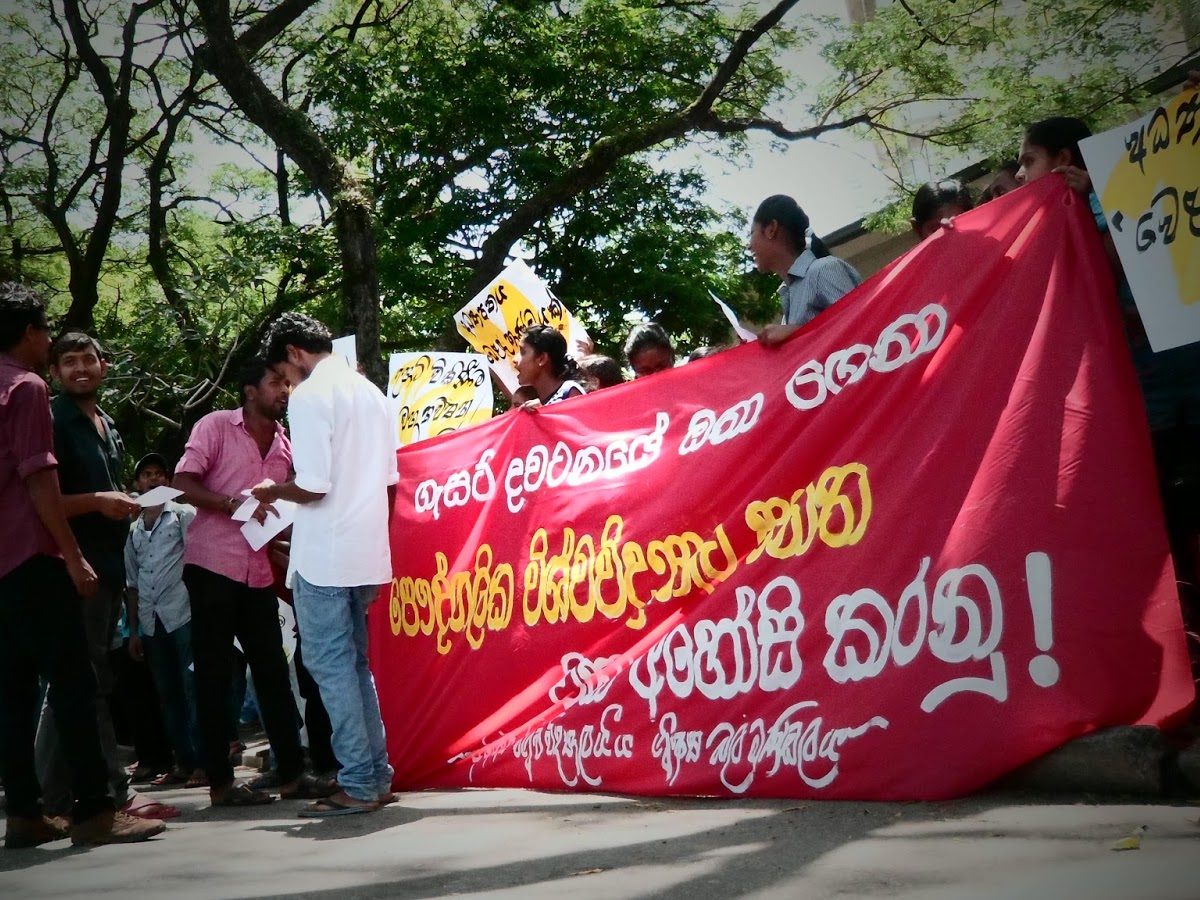
We Sri Lankans continue to witness protest marches and “sathyagraha” up on “attala” in front of majority of government universities.
The origin of these protests can be traced back to the institution of the private medical faculty in malabe (SAITM) in 2009.
From the very onset of SAITM, this university has faced hostility from GMOA and the inter university students federation alike. And their slogan “education is a right, and not a commodity ”
To the general public, this gives rise to another dilemma. Is only medical education a right and not a commodity? Since there are hundreds of other private educational institutions offering various degrees and diplomas varying from engineering to management to media to IT etc…
This recurrent question is answered by the protesting parties by extending their campaign and going against all private education institutions (SLIIT, NSBM, etc.).
Therefore we should concur that any form of education to be valid in Sri Lanka it should be government funded and free of charge?
But, it is not so, even according to those who protest, because those who obtain degrees from private universities, are welcome in Sri Lanka.
The main argument put forward by the protesting parties are quality control and sustaining the free education system in Sri Lanka.
It is quite fair to request for quality control of the degree programs in private universities and to clamour to sustain the free education system for the benefit of the financially less fortunate students very justified causes to protest.
But, there seems to be a double standard behind the monocular vision of these radicals which increase the field of vision but reduces depth perception.
This disparity is evident in quality control of medical graduates from specific foreign universities accredited by the Sri Lanka medical council. There are close to 100 foreign medical colleges accepted by the SLMC and the question arises whether the quality of all these are assessed regularly by the medical council?
Is it not more feasible to control the quality of a privately funded private university which does not eat up the budget allocation for education?
The latest statistics have shown that approximately 350 students enrol in foreign universities annually to study medicine alone. And it has been calculated that approximately 525 million Sri Lankan rupees are paid to these universities for tuition fees alone annually. This outflow of local currency has a debilitating effect on the local economy.
In an era where Sri Lanka is looking into new ventures to attract foreign currency education is one aspect which has huge promise, though in the current context it might just be another mirage.
In 2014, out of the 143740 students who qualified for university, only 25200 students gained entrance into the local university system. Which is 17.53% of the total qualified number.
What is the fate of the rest of the 82.47% of students? Due to the fact that the government budget allocation for education is inadequate to accommodate them in government universities are they to be deprived of the right to education? Is the right to education only for those who were lucky enough to gain entrance to government universities?
Are we not violating their human rights by denying them of their right to higher education?
Its high time Sri Lanka comes out of the leftist mentality and follow a more progressive path for the betterment of our nation. Or we are going to be left with an uneducated majority with no job scope and dependant on foreign professionals to get the job done.
Time to think hard Sri Lanka!


